What
is a Rife Machine?
 |
| |
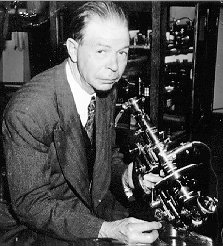
Royal Rife |
| |
What is a "Rife
machine"? A Rife machine is a research instrument
invented by Raymond Royal Rife. Rife
machines are devices which emit low band electromagnetic audio
frequencies or slightly higher radio frequencies applied
in some fashion to an individual with
the intent of bettering the individual's
health. They are used by experimenters, both
practitioners and private users alike,
to influence the body in making chemical
changes. We use the term experimentation
deliberately, as that is exactly what
this is.
A true
"Rife machine", of course, is one made
by Royal Rife himself. All others
must be considered copy cat devices,
simply based on his theories. Most
of these devices are referred to as a "frequency generator" and are highly theoretical and
experimental in nature.
 A
Rife machine works on the principle of
sympathetic resonance, which states that
if there are two similar objects and one
of them is vibrating, the other will
begin to vibrate as well, even if they
are not touching. In the same way that a
sound wave can induce resonance in a
crystal glass and ultra-sound can be
used to break up kidney stones. In theory, a Rife
machine uses sympathetic resonance to
physically vibrate offending bacteria,
viruses and parasites resulting in their
destruction and eventual elimination from the
body. A
Rife machine works on the principle of
sympathetic resonance, which states that
if there are two similar objects and one
of them is vibrating, the other will
begin to vibrate as well, even if they
are not touching. In the same way that a
sound wave can induce resonance in a
crystal glass and ultra-sound can be
used to break up kidney stones. In theory, a Rife
machine uses sympathetic resonance to
physically vibrate offending bacteria,
viruses and parasites resulting in their
destruction and eventual elimination from the
body.
Royal Rife
seemed to think this was the case, as evidenced by this
excerpt from a
letter
by Royal Rife himself. (among many other reports
from himself and fellow researchers.)
Another theory of illness and
disease (as it relates to thus topic) is that these "dis-ease" states reflect
low energy conditions in the body.
Perhaps the frequency energy absorbed
from a Rife machine may simply be
sufficient to re-energize the body’s
healing capabilities...? (Dr. Clark and many
other researchers seem to agree. Just look at the
field of magnet therapy alone.)
Several
types of modern day "Rife
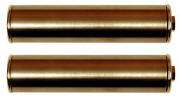
machines" exist. Some with hand-held
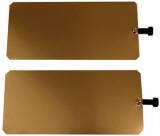
cylinders or contact pads connected to
audio generators with wires, while others use high
voltage and wattage to energize plasma lamps,
similar to fluorescent tubes, while the
individual sits nearby being exposed to
the modulated light energy.
Note:
These
devices have not been
approved in the U.S. for treating illness
with humans. It has, however, been
approved for use in veterinary
applications in the US. Little
formal medical research has been done in
the US; however, several types of
frequency devices are medically licensed
in Germany and a few other countries.
Although almost no empirical data exists here in the U.S. (no
doubt due to the FDA's attitude toward self-health and
freedom), there are 1000s and 1000s of people who have reported
their own successes. This is undeniable. Is
this scientific data? Perhaps not, but it certainly begs
the question, why is this science NOT being
studied fervently in clinical settings?
Of
course these devices don't work for everyone. What does? But it raises many questions. Why not? Were these
unsuccessful people using the right frequencies? Was their
device underpowered? Were they too late? Were they
still smoking, drinking, and eating GMO processed dead food and
tap water? Were they continually exposed to environmental
toxins that continually poisoned their bodies and kept their
immune systems from working properly? How many vaccines were they
given in their lifetime? There are many issues to be
examined.
For those who
want to learn more about Royal Rife, his
amazing machines, and up-to-date research in
this field, we recommend the
following book.
A
large amount of history in using frequency
devices is included. Extremely interesting
and valuable reading!!
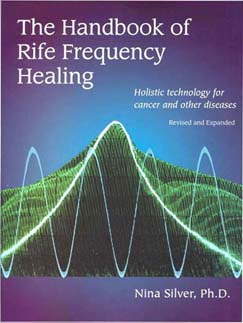 Comments
on "The Handbook of Rife Frequency
Healing": Comments
on "The Handbook of Rife Frequency
Healing":
"There is a complete paucity of well written
material on Dr. Royal Rife. Resonant Frequency
Therapies are essentially unknown to the
populace as a whole. Yet hundreds of thousands
of people, from the skilled professional to the
layperson, are using such devices with
phenomenal success in the treatment of disease.
Dr. Rife's innovative technological discoveries
involve many different scientific disciplines,
and groundbreaking research in optical physics,
electronics and the electronic treatment of
disease. His legacy upsets the present
scientific paradigm, but will eventually reshape
our world. Dr. Silver's book should do much to
dispel the clouds of ignorance of the genius of
Dr. Rife, and help open the minds of people to
what is now a worldwide technological shift.
This Handbook is long overdue". -
James E. Bare, DC, Chiropractor, and Inventor of the patented
Rife/Bare frequency therapy device
Phyllis A. Balch,
CNC and author of "Prescription for Herbal
Healing, Prescription for Dietary
Wellness, and Prescription for
Nutritional Healing" has this to say:
"This meticulously researched book examining
the discoveries and inventions of Royal Raymond
Rife provides new and ample documentation to
lend credence to his theories. In addition, Dr.
Silver's supporting information on a variety of
wellness issues is fascinating. The chapters
'The Politics of illness and the Nature of
Health' and 'Suggestions to Strengthen and
Support Your System' are a compilation of
cutting edge data, brilliantly interpreted. It
is rewarding to see a new generation of health
professionals postulating what I have been
saying for 30 years. If you are interested in
exploring Rife frequencies as an alternative
source, or in acquiring new information to help
with decisions about your health, this book will
be a valuable addition to your library."
We currently don't have this
book available. Buy it here.
https://nenahsylver.com/
20,000,000Hz Frequency Generator
(device not shown)
|

Sorry,
due to FDA and contractual
constraints, we can not display the frequency generator we carry by
name
on this website. To get full details and see it up
close, just email us right now with this link below.
You
will receive an 'auto-reply' immediately with model,
pricing, details, etc... Thank you.
rifemachineinfo@gmail.com
We do NOT share your email
and we won't spam you, we promise.
Or call to speak with us directly.
This is not
a ProWave 101, Wellness Pro, Global Wellness, Energy Wellness,
Detox Box, Wright Laboratories, RPG 900, BCX 211, Bio
Solutions PERL, Plasma Plus, or EMEM Ray Tube type
frequency generator. |
|
 |
Stand
Alone Frequency Generator:
Unlike some generators on the
market, this is designed to be a
simple, easy to operate, stand
alone frequency generator
requiring no complicated
computer interface. Computer
operated generators can
generally work well if power
output is adequate (which is
most of them), but many people
have commented on how confusing
the software can be with some
products. Our customers
appreciate that they are not
required to have a computer to
operate any of our instrument's
capabilities. |
|
|
|
Broadcast Capable with Light
Tube, or Apply Direct to Body
With Metal Hand Cylinders & Foot
Plates: |
| |
- Purchase separately *
|
- Purchase separately *
|
|
|
|
Frequency range:
0.01 to 20,000,000 Hertz. |
|
|
|
Waveforms: Square and Sine
wave. Square wave up to 400,000 Hertz. Sine to
20,000,000 Hertz |
|
|
|
Two circuits.
"Audio Mode" circuit capable of outputting
8
square wave frequencies simultaneously from 1 to 40,000 Hertz.
And also 1 square wave frequency
at time up to 400,000 Hertz! (This circuit
uses NO RF carrier frequency.)
|
|
|
|
Two circuits. "RF Mode" circuit capable of outputting
8
square wave frequencies simultaneously from 1 to 40,000 Hertz
'piggybacked' onto a 3.1 Mhz
Carrier Frequency. (like
Dr. Rife!) Also,
capable of running 1-2 RF frequencies from
40,000Hz - 20,000,000 Hz. For best results, leave it in
this mode. |
|
|
|
Carrier Wave:
3.1 MHz RF
(3,100,000 Hertz Radio
Frequency) for more power for deeper penetration.
The RF carrier wave also produces
'sideband harmonics' like Rife's original 1930's, 1940's
and 1950's equipment! This is an important
part of Rife's own successes.
(in his own words) NOTE: Carrier wave can be turned off so the
user can operate it as a
standard audio frequency generator like most on the
market today. |
|
|
|
Power output:
RF Mode: Variable up to
4.7 watts
(RF = Radio Frequency) |
|
|
|
With Optional
RF Mode
Amplifier: Variable up to
15 watts |
|
|
|
Power
output: Audio Mode: Variable
up to .75 watts |
|
|
|
Voltage output in RF mode: 110 volts.
(47 times
more powerful than most standard frequency
generators.) |
|
|
|
Voltage output in Audio Mode:
36 volts |
|
|
|
Time Saving
Feature: Simultaneously Runs 8
audio frequencies
(1-40,000Hz), and Simultaneously Runs 2
frequencies from 40,000-20,000,000 Hz. (HUGE TIMER
SAVER) |
|
|
|
883 Preset
Channels. Comprehensive and easy-to-run PRESET
Channels allow you to start experimenting immediately.
(A Channel stores frequencies
for easy use.) |
|
|
|
Channel capability:
48 Run up 48
frequencies in sequence, or in 6 groups of
8 frequencies each.
|
|
|
|
Programmable channels: 2000.
883 preset Channels leaves you with 1,117
blank Channels.
You can use these to make your own "Custom Channels"
that will remember the frequencies you load into it. |
|
|
|
Outputs: Four. 2
positive (red) and 2
negative (black). Using 4 points of contact
(hands and feet) allows more signal to permeate the
body. |
|
|
|
Frequency output:
Digitally
accurate frequencies. (converted to analog using a Digital-to-Analog
convertor) |
|
|
|
Resolution: 1/100th of a Hertz: (7.83
Hz)
Beyond this is unnecessary. |
|
|
|
Duty cycle capability: 10% to
100% square wave duty cycle. |
|
|
|
Gating (or pulsing) range: 1 -
5000 Hertz (advanced feature....
you don't have to use this) |
|
|
|
Gating duty cycle range: 10%
- 90%. 'Save Gating' Feature: Allows you to
save, in any channel, gating turned ON whenever that
channel is used. (advanced feature....
you don't have to use this) |
|
|
|
Sweep Feature:
Run 1 frequency at a time, from 1 to 20
million Hertz. (A Sweep runs ALL frequencies
between 2 chosen points. Ex: 10,000Hz - 20,000Hz)
|
|
|
|
Converge sweeps:
Run 2
frequencies at a time, from 1 Hertz to 20 million Hertz. |
|
|
|
Channel sweep:
Variable,
2 Hertz - 20,000 Hertz. The feature allows you to
'hover' above and below your target frequencies.
This helps to prevent the organisms from adapting.
(Ex. A 1000 Hz Channel Sweep on a frequency
of 10,000 would sweep from 9,500Hz to 10,500Hz)
|
|
|
|
Display: LCD |
|
|
|
L.E.D: RF indicator light confirms RF output.
|
|
|
|
Computer software:
Not a
necessity really. It is mostly used for programming
your own custom channels, or restoring any lost programmed channels
that may be accidentally deleted. |
|
|
|
Worldwide AC Adapters: Two switching
110/240 volt power supplies for worldwide use. |
|
|
|
DVD Training Guide
and Paper Operations Manual. |
|
|
|
Free lifetime
phone support. |
|
|
|
Free software
updates (when rare updates occur.) |
|
|
|
90 Day Money Back Guarantee
(less shipping cost) if returned in new condition. 10%
restock fee. |
|
|
|
Two Year Warranty on
parts and labor. |
|
|
|
Broadcast
Capable w/Optional Amplifier & Plasma Tube! |
| |
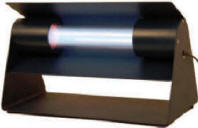 A
master oscillator
combined with a powerful amplifier is needed to use the
gas filled tube method of broadcasting the frequencies. If you are
wanting to use the more powerful, versatile
1930's/1950's radiant method, then this
amplifier is the instrument you will want to own. A
master oscillator
combined with a powerful amplifier is needed to use the
gas filled tube method of broadcasting the frequencies. If you are
wanting to use the more powerful, versatile
1930's/1950's radiant method, then this
amplifier is the instrument you will want to own.
-
Power output: 190 watts
-
Ability to run up to 8 frequencies (up to 40,000
hertz) through a gas filled tube. No other
instrument has this capability! (Rife ran up to 10 at a
time.)
- Original plasma gas filled vacuum tube with the ability to use a
variable frequency from 1 to 20,000,000 million Hertz.
It also has a variable built in carrier frequency which
goes from about 2.2 to 3.8 MHz.
- Uses the superior high voltage - low current
design over the low voltage - high current design. |
| |
|
|
|
Hands free
Operation / Run it While You Sleep Useful range is
about 30 feet when using gas tube. However, due to the laws of
physics there are limitations to gas filled tubes and
metal antennas that need to be understood. Both are very
efficient and about 100% of the energy that you put into
them comes out. But for every foot that you move
away from these antennas you lose 75% of the power they
output. Example: With a 207 watt
output, at one foot away from the gas filled tube you
will get 47.5 watts. At two feet away you
only have 11.85 watts, and at 3 feet you only have 2.97
watts. Because of the laws of physics it is important to
be as close to the gas filled tube as you can get if you
want the greatest amount of the energy that comes out of
it. One to three feet distance away from the gas
tube would be the best choice for maximum results.
Closer the
better.
Suggested range:
1 inch to 6 feet. Because
there is NO 1 foot to 3 foot 'null zone' (non-effective range,
as some manufacturers state!)
it is not necessary to stay 3 to 6 feet away from the
gas tube because it outputs the same as the
1930's/1950's equipment that was used within 6 inches of
the target area. |
| |
|
Why Power
Output Is Important In A Frequency Generator
When comparing the various
instruments, power output is a very important
consideration. More power means better
signal strength, which in turns means deeper
penetration along with a better quality
wave.
The power output of most frequency generators on the
market today that do not use an RF carrier frequency
is about 0.20 (1/5th) of a watt.
With the use of the RF carrier frequency,
4.7 watts is almost 25 times more powerful than these
instruments. With the use of the optional 15 watt
RF amplifier, it is 75 times more powerful!
Power and Running Multiple frequencies
Back in the 1950's Dr. Rife built a ray
tube instrument that would run 10
frequencies simultaneously. So running
multiple frequencies is not new! Yet
today there are some unknowledgeable people
who want to disparage running multiple
frequencies. Successfully running
multiple frequencies is directly tied to
power. If you have enough power then
it IS possible to do this.
Does running multiple frequencies reduce the
power level of the frequencies?
The answer to that question would
normally be yes... if you did not increase
power levels. This is why this
generator was built to output 4.7
watts using a RF (Radio Frequency)
carrier wave. Using the RF carrier frequency is the only way the
power level could be increased. The original 1950’s equipment did
not use an RF carrier frequency, so they could only output one audio
frequency at a time with only 1/5th of one watt of power (0.20 of
one watt). This power level worked well with only one audio
frequency at a time. In order to overcome this limitation, our 20Mhz generator uses two
separate circuits.
The Audio Mode circuit has
no RF carrier frequency and 0.75 watts
power output. It is used for frequencies from 1 Hertz to 400,000
Hertz. MANY frequencies used with this Audio Mode circuit can be
physically felt from 1 to about 20,000 Hertz. (electrical
'ticking' sensation)
The
RF Mode circuit is used for frequencies from 1 Hertz to 20
million Hertz. The 3.1 MHz carrier frequency is also driven with
this circuit. When using the RF carrier, audio frequencies can not
be felt. By using this method, it is possible to use 4.7 watts
(15 with the amplifier) and makes it possible to run up to
8 frequencies
simultaneously.
Logically, if you use
2 audio frequencies you would want to double
that power level to 0.40 of one watt.
(2 X 0.20 = 0.40 of one watt)
If you run up to 8 audio frequencies you
would want at least 8 times that power level
or 1.60 watts peak power. This is why our
generator has 4.7 watts of power... so that
it has over 3 times the power capability needed for running 8 audio
frequencies simultaneously at the original 1950’s capability of 0.20
watts of power for one audio frequency.
Some people also ask if they can
ONLY run multiple frequencies. The
answer to that question is NO. This generator gives you the flexibility
to switch from running one audio frequency at a time, to being able
to run up to 8 audio frequencies at a time. You can choose how you
want to run the frequencies.
Many people want even more power! If you want
even more power then you can purchase the
optional 15 watt amplifier!
What separates our frequency generator from others available
today?
First,
the time saving feature. While almost all manufacturers only run one frequency at a time, this
generator can run from 1 to 8 frequencies simultaneously. The benefit of running
frequencies simultaneously is it SAVES A LOT OF TIME.
The industry standard 'Run Time' per
frequency is 5 minutes. So... If you
run 1 frequency at a time, then 8
frequencies would take 40 minutes to run. But if you run those
8 frequencies simultaneously, then it would
only take 5 minutes
to run all 8 frequencies.
This generator can output up to 8 frequencies simultaneously up to
40,000 Hertz (Audio Mode only), and 2 frequencies up to 20,000,000 Hertz
(RF Mode). Each frequency is generated and output in a pure
waveform. With its 20 MHz frequency range,
it has the ability to generate millions of
individual frequencies in pure waveforms.
Some manufacturers claim that running multiple frequencies
simultaneously causes the purity of each individual waveform to be
lost, as well as creating the possibility of canceling out or
creating other frequencies. In order for a frequency to be canceled out, the same frequency must
be introduced 180 degrees out of phase.
Since
this generator does not
output the same frequency 180 degrees out of phase, the canceling of
a frequency is not possible. (side note: this is how
scalar waves are produced)
Even though frequencies combined together may seem to lose their
individual clarity, all the components of each frequency are
present. Think of an orchestra playing many different instruments.
Though they combine together to make beautiful music, each
instrument’s full sound components are still present and nothing is
lost.
Very rarely are other frequencies created, and when they are, they are
generally beat frequencies, which are considered beneficial.
Second, the use of
the 3.1 Mhz RF carrier wave frequency
provides better penetration through
tissue, while at the same time
generates 1000's of sidebands harmonics.
(RF = Radio Frequency)
This is a DESIRED effect. By Rife's and
Hoyland's own admission, they weren't
positive whether is was the base frequency
being run, or possibly one of the sideband
frequencies that was doing the trick. It is
almost always best to use the carrier.
However, you can turn it off with the press
of a button if you want to try it both ways.
With no RF, you have a very basic device
like most on the market.
Common Questions
(see the
FAQs for
more details)
Audio Frequencies vs.
Radio Frequencies - What is the difference?
In a nutshell,
Radio
Frequencies (RFs) are higher than Audio Frequencies. The
science shows that more power and more cycles per second (higher
frequency), allow the signal to penetrate more deeply. The first
known frequencies from the 20's and 30's were in the millions
of hertz range. (like our generator)
So why do most of the instruments
built today only use low audio frequencies, when original
frequencies were much higher? The FCC (Federal Communication
Commission) is the main reason why. In 1935 Congress created the FCC
and by 1936 they began to regulate the airwaves. Before 1935 there
were no regulations to prevent Dr. Rife from using his high
frequencies output through a plasma powered ray tube. The
frequencies output through the ray tube would travel about 12 miles
in each direction from his laboratory, and would. Dr. Rife said his
equipment would “raise the devil” with all the radios.
 In
1936, Philip Hoyland built the first audio frequency
instrument. (right) In these early designs, a radio frequency was
used to "carry" a newer set of lower audio frequencies into the
body. (like our generator does) In
1936, Philip Hoyland built the first audio frequency
instrument. (right) In these early designs, a radio frequency was
used to "carry" a newer set of lower audio frequencies into the
body. (like our generator does)
In the 1950s, Rife's research
partners John Crane and John Marsh
continued to build this lower audio frequency instrument, using
simple off-the-shelf technology of the day. From this time on, Dr.
Rife’s original high frequencies were no longer used in any of the
equipment, nor were his RF carrier waves used.
Most of today’s modern
frequency generators are patterned after these early 50's style
instruments.
Without the RF carrier frequency,
they couldn’t get the same harmonics and penetration as the earlier
ray tube instruments. This is why our frequency generator does
use a RF carrier wave. A very simplified way to think of this is
this: when you hear a song on the radio, it is audio
frequencies that you are hearing. However, these audio frequencies
are brought to your radio antenna by a modulated radio frequency, or
"carrier wave". The audio frequencies are "piggy backed" onto the
radio frequencies. This "RF" carrier signal simply delivers the
lower audio signal deeper. (which is what you want)
Square Wave vs. Sine
Wave
Another debate within this field
is "which wave format to use?" Before the newer instruments were
developed, all the generators output only radio frequencies, or "RF".
When emitting these radio frequencies, the sine wave format is
produced. Basically because this higher frequency range (in
the millions of pulses per second, or hertz), creates a wave form
that is naturally rounded at the top and bottom. It's more
difficult to create very sharp signals at this high rate of
oscillation.
With advent of the newer
Crane/Marsh design, the rate at which these signals are emitted
dropped substantially into what is referred to as the Audio
Frequency range. (this was not a desired design aspect at the
time.) With these lower frequencies, the signal can be very
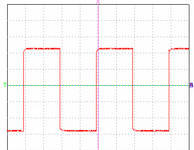
sharply turned on and off, as seen below. This square wave
design is used when running the lower audio frequencies.
One important reason is because it helps to better create
entrainment between the signal being emitted and the target. The
principle of entrainment is at the very foundation of this entire
science.
|
Entrainment is defined
as the "tendency for two oscillating bodies
to lock into phase so that they vibrate in harmony." It
is also defined as "a synchronization of two or more
rhythmic cycles". The principle of entrainment is
universal, appearing in chemistry, pharmacology,
biology, medicine, psychology, sociology, astronomy,
architecture and more. |
|
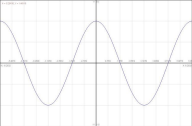
In the Radio
Frequency range, a sine wave pattern is
desired & generated.
(above 40,000Hz) |
|
In the lower
Audio
range, a square wave pattern is desired and
generated. (below
40,000Hz) |
 |
|
 |
|
Sample Sine
Wave |
|
Sample Square Wave |
|
Signal gently rises and falls. Can vary the rate of this
rise and fall, top and bottom limits, etc...
|
|
Signal sharply turns on and off. Can vary the rate of
this "on/off" signal. (Note:our device
now can produce square waves to 400,000 Hz) |
Analog vs.
Digital
The question always arises
about the type of signal that should be used. It is generally
accepted that the most effective of these frequency
generating devices will deliver an analog signal, versus
a digital signal. Analog is better because it is a
more natural frequency. It includes the sub-tones and overtones
to the base number, providing a maximized fullness, essentially
a richness of tonal qualities. A very big part of that is what
is called the harmonics. An audiophile understands this. Those
who desire only "true" sound on their stereo systems insist on
analog devices for just this reason.
The current analog vs. digital discussion is wrought with
misconceptions and disinformation. Such as, digitally generated
frequencies do not vary, which implies that they do not have
overtones and undertones. This would only be true if the
frequencies remained digital. That is why digital
frequencies from DDS (Direct Digital Synthesis) and DSP (Digital
Signal Processing) are converted to analog before they are put
out. These Digital-to-Analog Converters
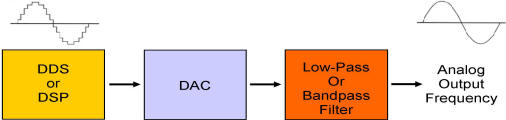
are called a DAC for short. You can see in the diagram below
that a frequency comes out of a DDS or a DSP looking like
stairs. The signal then goes through a DAC or Digital-to-Analog
Converter. Then it goes through a Low-Pass or Bandpass Filter to
finish the analog conversion. Now the frequency that you have is
a very accurate analog frequency with all the overtones and
undertones of that analog frequency. The analog frequency
produced by a digital chip can be swept up or down with more
accuracy than any old tube analog instrument. The most important
thing to remember is the frequency has to be converted to analog
before it is output from the frequency generator.
Digitally produced
frequencies converted to analog are far superior to any signal
that comes from an old antique tube type analog frequency
generator. Antique tube type generators are very limited. If I
want a frequency of 2128.5, an old tube analog generator would
not be accurate enough to give me that frequency to use. It
could only give me 2128. Also, digitally converted frequencies
allow me to sweep with far more accuracy than old analog tube
type instruments. Even a thousandth or millionth of a frequency
is possible even though this kind of accuracy is not needed.
This is something that a purely analog instrument could not do
as accurately. Digitally produced frequencies when converted to
analog can accurately produce minute details. These analog
frequencies when converted to a square wave waveform produce
square wave harmonics. Some claim that their instruments which
output analog frequencies produce advanced analog harmonics, but
this is just sales hype. All the digital-to-analog frequency
generators on the market today that have been tested with a
spectrum analyzer produce the same analog harmonics. Anyone
claiming to have some form of superior advanced square wave
harmonics is just giving you lots of sales hype. (Our frequency
generator uses this technology, of course.)
Output of
Contact Pad type instrument vs. Ray Tube?
Contact instruments deliver frequencies through direct contact,
while plasma ray tube instruments transmit frequencies indirectly
through the air. Direct contact makes it possible to get the full
energy into the body without power loss. Indirect contact though a
plasma tube (broadcast method) is efficient also, but a bit more time
consuming and cumbersome, as ray tubes should be held within several
inches of the body. The tube is waved over the entire body or
target very slowly, or you sit very close to a stationary light
tube.
Many people
believe that you can simply sit in the same room with one of these
plasma ray tubes to get the full effect... this is
incorrect!
The laws of physics in regards to
signal loss come into play when using a ray tube. It requires
much more power at the frequencies to deliver its output. For every foot that you move the ray tube away from the body you
have to divide the power output by the ray tube by a factor of 4.
Example: If you have 50 watts of power coming out of a ray
tube, then at one foot away from the ray tube you only have 12.5
watts. At two feet you only have 3.125 watts and at 3 feet you only
have about .78 of a watt. Because of this loss, researchers and
doctors from the 30's had to stay within
6 to 12 inches of the
body with the ray tube.
Today, many ray tube instruments
output about 100 watts or more. (Our MOPA outputs 190 watts).
Some manufacturers recommend those
who use them to stay at least 3 feet away from the ray tube, due to
some notion of a "null zone", which DOES NOT EXIST with a true
gas filled lamp. In fact, JUST THE OPPOSITE IS
TRUE! (this industry is a minefield of
misinformation!) Stay within 3 feet
for best results!
With a direct contact instrument, this power
loss is not a problem. Direct contact also requires much less power,
as the body is essentially the 'antenna'
pulling in the signal. Both methods
have their benefits.
|
20,000,000 Hz Frequency Generator
Sorry,
due to FDA and contractual
constraints, we can not show you the frequency generator we carry by
name
on this website. To get full details and see it up
close, just email us right now with this link below.
You
will receive an 'auto-reply' immediately with model,
pricing, details, etc... Thank you.
rifemachineinfo@gmail.com
We do NOT share your email
and we won't spam you, we promise.
Or call to speak with us directly.

This is not
a ProWave 101, Wellness Pro, Global Wellness, Energy Wellness,
Detox Box, Wright Laboratories, RPG 900, BCX 211, Bio
Solutions PERL, Plasma Plus, or EMEM Ray Tube type
frequency generator. |
Rife machine
Disclaimer:
We
are not licensed medical professionals, nor do we imply so. We
do not prescribe, diagnose, or provide medical services or
advice in any way. Statements
contained on these pages about a rife machine, alternative medicine, or any other topics have not been evaluated by the Food
and Drug Administration. The information found here is not
intended to diagnose, treat, cure, or prevent any disease.
Rife
machine page is for information only.
|
















.png)











.png)
































.png)



































.png)